
Insight
Ads Are Now Showing Up in ChatGPT. Should Your Business Buy Them?
ChatGPT ads are open to businesses in dozens of countries. How they work, what early advertisers are seeing, and how a small business can test them without wasting money.
The short version
- ChatGPT now shows ads, labeled "sponsored," under some answers for people on its free and low-cost plans.
- Businesses can buy these ads themselves, with no minimum spend, in dozens of countries, including the US, UK, Canada, Australia and much of Europe and Asia.
- Early results are all over the place. Some advertisers report decent returns, others spent thousands for one lead or none. OpenAI itself says it doesn't have performance benchmarks yet.
- Our advice: if your customers research purchases by chatting with AI, run a small, carefully tracked test. Don't move your main budget yet.
What's happening
Millions of people now ask ChatGPT for advice before they buy: which accounting software to use, which sofa fits a small apartment, where to stay on a weekend trip. In 2026, OpenAI started putting ads into those conversations.
Here's the timeline in brief:
- February 9, 2026: OpenAI started testing ads in the US for logged-in adults on its Free and Go plans.
- May 5, 2026: a self-serve Ads Manager opened to US businesses, and the $50,000 minimum spend from the early pilot was dropped.
- August 24 and 31, 2026: ads switched on in 31 European markets, followed a week later by self-serve buying there.
- October 2026: according to the industry site MACCUS, OpenAI's help center listed 63 countries where businesses can buy ads themselves. OpenAI also says the ad business passed a $1 billion annual run rate across more than 40 countries and tens of thousands of advertisers.
Who sees the ads and how they look
Ads appear only for people on the Free and Go plans. People paying for Plus, Pro, Business, Enterprise or Edu don't see them, and neither do users OpenAI believes are under 18.
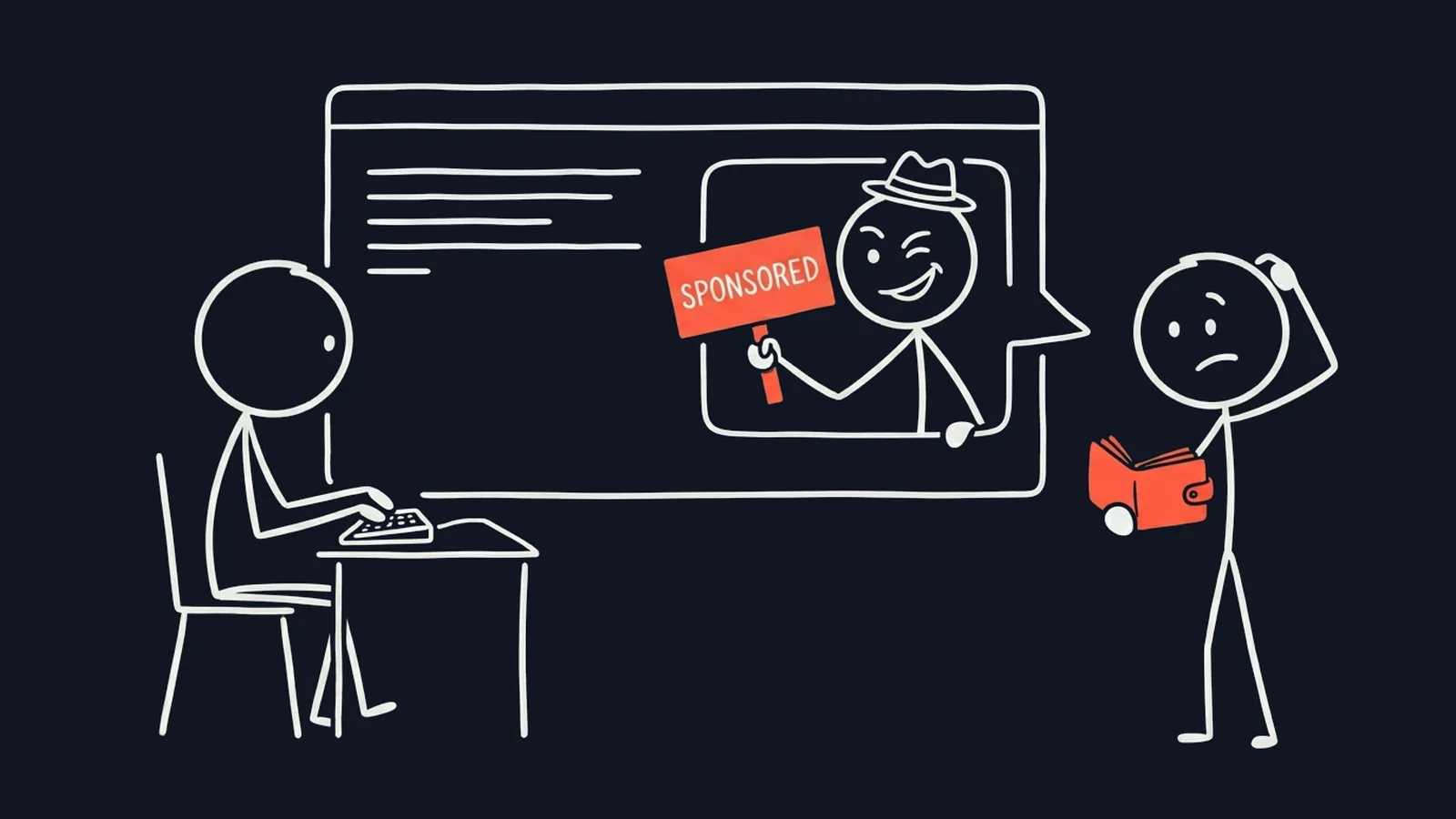
The ads appear below ChatGPT's answer, are labeled "sponsored" and are visually separated from the response. OpenAI says ads don't influence the answers ChatGPT gives, and that advertisers only receive overall figures such as views and clicks, not people's conversations.
How targeting works
ChatGPT ads don't work like Google keywords. Instead, advertisers write context hints: plain-language descriptions of the kinds of conversations where their ad would be relevant. When OpenAI announced its European expansion, it gave examples such as planning a trip, choosing software for a business and shopping for home furnishings.
Advertisers can pay per thousand views or per click, and OpenAI recommends starting click bids of around $3 to $5.
New features keep arriving
On September 16, OpenAI started testing Sponsored Agents (an ad that opens a conversation with the business's own AI agent) with selected US advertisers, and launched integrations with HubSpot and Shopify. US Shopify merchants got a free ChatGPT Ads app that turns their product catalog into ads, with other markets following from September 23. In October, OpenAI announced a visual ad format to be tested first in the US.
What people are saying
"Nobody knows what 'good' looks like yet"
Search Engine Journal looked at six months of ChatGPT ads and found that OpenAI doesn't yet publish performance benchmarks across advertisers, industries or campaign types, and that the results advertisers have shared vary widely.
The early numbers are mixed
- A disappointing B2B test. Agency Workshop Digital spent $2,319 on a B2B test and got 739 clicks at about $3.14 each (a 1.1% click-through rate), but no qualified lead.
- An expensive lead. Marketing firm GrowthLine, discussing its client work with Localogy, reported 314 clicks at an average of $8.12 each that produced a single lead, for a cost of $2,550 per lead.
- A more promising result. Opascope published 15 days of results from a live account with a 2.35% conversion rate and said ChatGPT ads landed somewhere between search ads and social ads on efficiency, while warning that early-days pricing may not last.
The pattern: the channel can work, but it depends heavily on what you sell, how your ad is written, and how good your landing page is.
What this means for your business
Here's our take.
1. It's real, it's open, and it's early. You can now buy ChatGPT ads without an agency or a big minimum budget. But with no published benchmarks and very mixed early results, you're paying to learn, not buying a proven channel.
2. It suits some businesses far better than others. ChatGPT ads make most sense when people research and compare before buying: software, home furnishings, travel, professional services, considered purchases. They make less sense for impulse buys or for "near me" emergency services, where Google Search and Maps still dominate.
3. Your landing page has to work harder. Someone clicking from a detailed conversation with ChatGPT already knows a lot. A generic homepage won't satisfy them. Send them to a page that answers the specific questions they were asking.
4. Don't forget the free version. Getting mentioned in ChatGPT's actual answers costs nothing per click. Clear, specific, trustworthy content about your products and services (the same work that helps you appear in Google's AI answers) is often the better long-term investment.
5. Get the basics right first. If your Google Ads and Meta ads aren't tracked properly and profitable yet, fix that before adding a brand-new channel.
What to do this month
- Check availability. Find out whether self-serve ChatGPT ads are open for businesses in your country (OpenAI's Ads Manager is at ads.openai.com).
- Ask your customers. Do they use ChatGPT or other AI assistants when choosing a business like yours? Their answers will tell you if this is worth testing.
- If you test, keep it small and focused. Pick one product or service, set a fixed budget you're comfortable losing, and run it for three to four weeks.
- Write context hints like a customer would talk. Describe real situations ("a café owner comparing booking systems for a small restaurant"), not keyword lists.
- Track everything. Install OpenAI's conversion tracking and add UTM tags to your links so results show up clearly in your own analytics.
- Build a dedicated landing page. Answer the detailed questions people ask in ChatGPT: prices, comparisons, how it works, who it's for.
- Compare honestly. Judge results on cost per lead or sale against your Google and Meta campaigns before spending more.
Want help deciding if ChatGPT ads fit your business?
We'll do a free ChatGPT ads fit assessment: we look at your market, your products or services and your current ad results, check how ChatGPT already talks about your business, and tell you whether a test makes sense and how to set it up so the numbers mean something.
Sources
- OpenAI Help Center: Ads in ChatGPT
- LI Solutions: ChatGPT ads opened self-serve in Europe. Should your brand buy in?
- MACCUS: ChatGPT ads: what changes in October 2026 for small businesses
- ExplainX: OpenAI launches ads in ChatGPT: what advertisers and users should know
- SSD Nodes: Ads in ChatGPT: which plans show them
- Relevant Audience: OpenAI brings ads to Free and Go ChatGPT users across the EEA and Switzerland
- Search Engine Watch: OpenAI expands ChatGPT ads to 31 European countries
- Lapis: How to set up ChatGPT Ads Manager: step-by-step guide
- Flyweel: OpenAI ChatGPT Ads Manager: costs, billing and what changed in 2026
- Unite.AI: OpenAI tests Sponsored Agents and rolls out AI tools for ChatGPT Ads
- Search Engine Journal: 6 months into ChatGPT Ads, advertisers still don't know what "good" looks like
- Workshop Digital: ChatGPT Ads: what we learned from our first B2B test
- Localogy: ChatGPT ads: high potential, low performance
- Opascope: ChatGPT Ads benchmarks: ROAS, CPC and cost from 15 days of real spend