
Insight
AI Assistants Are Starting to Shop for Your Customers. Is Your Website Ready?
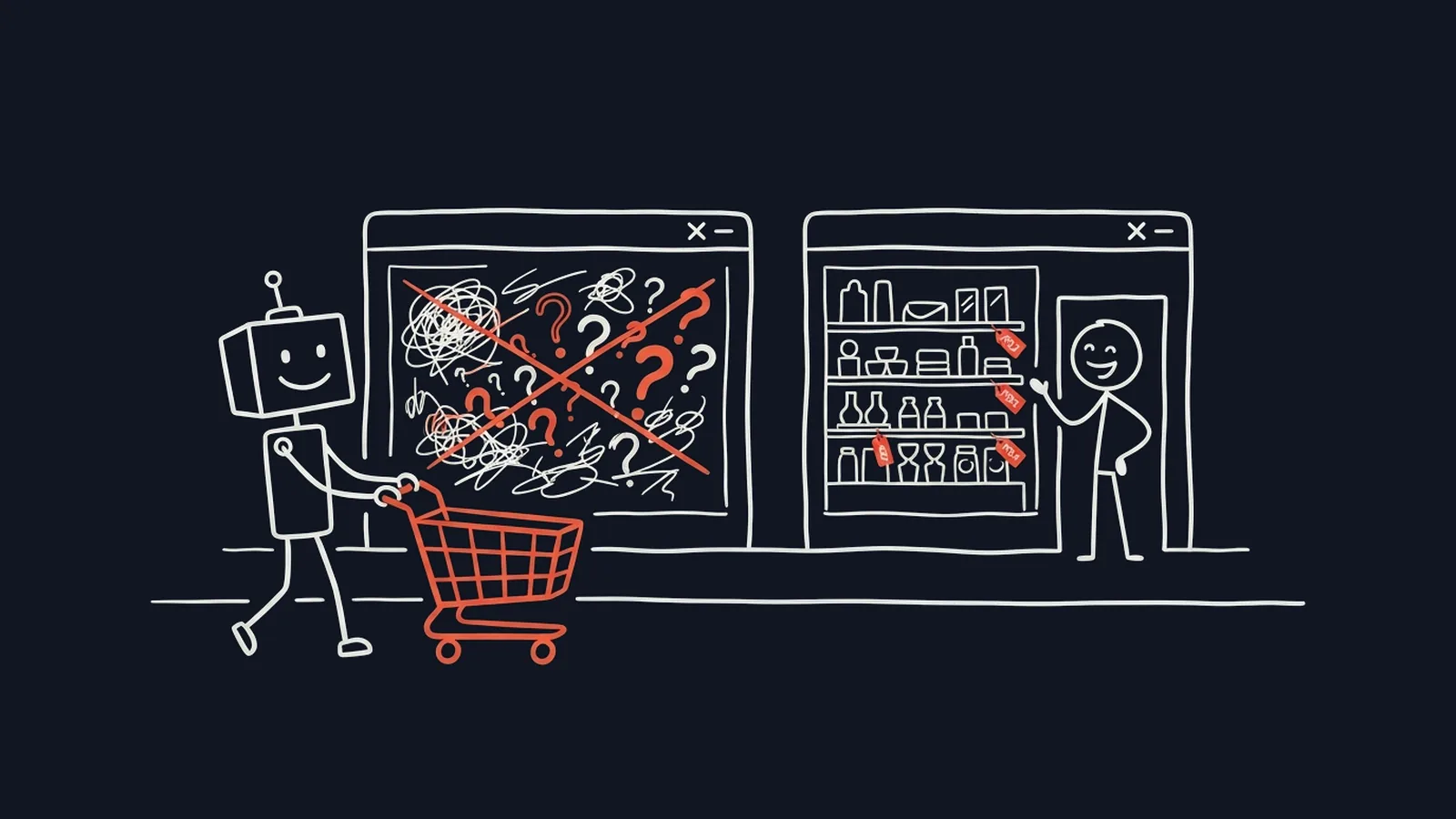
ChatGPT, Google and Shopify are building ways for AI to find and buy products for people. What's real today, what's coming, and how to make your website easy for AI to recommend.
The short version
- More and more shoppers ask an AI assistant (ChatGPT, Google's AI Mode, Gemini, Microsoft Copilot) what to buy. Tech companies are now building ways for those assistants to complete the purchase too.
- Today, the reliable part is discovery: AI recommends a product and the customer buys on the store's website. Buying inside the AI is still early, mostly US-only, and one big attempt has already been scaled back.
- The businesses that AI recommends are the ones whose product information, prices, policies and websites are clear and easy for a machine to read.
- You don't need to rebuild everything. You do need to tidy up your product data and make sure your website works for robots as well as people.
What's happening
Picture a customer typing: "Find me a waterproof hiking jacket under $150 that ships before Friday." Instead of ten links, the AI assistant compares options, reads reviews and suggests two or three products. In some cases, it can even take the customer straight to checkout.
The industry calls this agentic commerce: AI "agents" doing parts of the shopping on someone's behalf.
The big players are laying the groundwork
- Google introduced the Universal Commerce Protocol (UCP) in January 2026, an open standard developed with Shopify, Etsy, Wayfair, Target and Walmart. It's essentially a shared language that lets AI assistants talk to online stores: checking products, building a cart and completing checkout, while the store remains the seller.
- Shopify switched on "Agentic Storefronts" by default on March 24, 2026, making about 5.6 million eligible stores discoverable inside ChatGPT, Microsoft Copilot, Google's AI Mode and the Gemini app through a single setting.
- Google says it is gradually rolling out a way for US merchants to join UCP from their Merchant Center account, with Australia and Canada to follow next year. In September, it also made a report generally available that shows retailers how they're being discovered through AI.
One high-profile attempt has already been scaled back
OpenAI launched Instant Checkout in September 2025, letting people buy from some merchants without leaving ChatGPT. In March 2026, it changed course. OpenAI said it would let merchants use their own checkout and concentrate on helping people discover products instead.
Reports at the time said only a small number of Shopify merchants had actually gone live with in-chat checkout, and that the program hadn't driven the sales people hoped for. Retailers such as Etsy said ChatGPT remained valuable as a source of shoppers, just not as the place where the purchase happens.
What people are saying
"AI finds, your website sells"
That's the pattern that has emerged in 2026. In ChatGPT, shoppers discover products and then check out on the merchant's own site. Shopify reported that AI-driven traffic to its stores grew 8x year over year, while orders from AI-powered searches rose nearly 13x.
Shoppers want deals, and merchants are cautious
A September 2026 PYMNTS Intelligence report, based on surveys of US consumers and retailers, found that finding the best price or deal was the most common job people gave AI shopping tools (46% of AI-assisted shoppers). Merchants, meanwhile, are wary: only 28% would offer AI agents their full product range on the same terms as other channels, and 93% say the AI provider should cover the loss when an agent makes a wrong purchase.
Google: start with the basics
Google's official guidance for website owners describes how AI agents may visit your website to complete tasks such as booking or comparing products, by looking at what's on the page and how it's built. Its advice is practical: review the guidance on making websites friendly to AI agents, and keep an eye on protocols like UCP as they mature.
What this means for your business
Here's our take.
1. This isn't science fiction, but it isn't everywhere yet either. Buying fully inside an AI is still mostly limited to the US and to larger or Shopify-based merchants. AI recommending products, however, is happening now, worldwide, and it's the part you can influence today.
2. Your product information is your new shop window. An AI can't admire your homepage design. It reads your product titles, descriptions, specifications, prices, stock levels, delivery times and return policy. Vague, missing or inconsistent information makes it easy for the AI to recommend a competitor.
3. Expect more price and policy comparison. If AI assistants are mostly asked to find the best deal, then clear pricing, honest delivery estimates and easy returns become selling points the AI can actually "see."
4. Your website has to work for machines as well as people. Clean page structure, product data that machines can read, accessible forms and a simple checkout all help AI agents understand and use your site. Shopify stores get some of this automatically. Custom-built websites need it done on purpose.
5. Service businesses aren't exempt. The same shift applies to bookings: if an AI is helping someone find "a dentist who can see me Thursday," a clear online booking option and up-to-date availability give you a better chance of being chosen.
What to do this month
- Ask the AIs about yourself. Search for your main products or services in ChatGPT, Google's AI Mode and Gemini. Do you show up? Is the price, stock and description correct?
- Clean up your product data. Complete titles, specifications, sizes, colors, materials, real photos, accurate prices and stock levels. If you sell physical products, keep your Google Merchant Center feed accurate and complete.
- Add structured data to your website. Product, review, organization and local business markup help machines understand your pages. (Google says it isn't required for AI answers, but it remains useful for search overall.)
- Make your policies impossible to miss. Shipping costs, delivery times, returns and warranties should be on clear, readable pages, not hidden in images or PDFs.
- Test your checkout or booking flow. Count the steps, try it on a phone, check that forms are clearly labeled, and offer guest checkout. What's confusing for a person is usually worse for a machine.
- On Shopify? Check your settings. Look at the Agentic Storefronts settings in your Shopify Admin to see which AI channels your products are shared with.
- Track AI visitors. Set up your analytics to show visits coming from AI assistants, so you can see whether this channel is growing for you.
Want to know how "AI-ready" your website is?
We'll run a free AI shopping readiness check: we look at how AI assistants describe your products or services, review your product data, structured data and key policy pages, and test your checkout or booking flow. You'll get a short, prioritized list of fixes, written in plain English.
Sources
- Google Search Central: Optimizing your website for generative AI features on Google Search (section on agentic experiences)
- web.dev: Agent-friendly website best practices
- Google: Boost your holiday sales with these agentic commerce updates
- Search Engine Roundtable: Google Merchant Center new UCP integration hub
- commercetools: A merchant's guide to Google's Universal Commerce Protocol (UCP)
- Impression Digital: Navigating agentic commerce with the Universal Commerce Protocol
- Charle: Shopify MCP explained (Agentic Storefronts launch)
- Modern Retail: What went wrong with ChatGPT's Instant Checkout
- Storyboard18: OpenAI scales back ChatGPT shopping ambitions after weak uptake of checkout feature
- Elsner: Shopify news and updates (AI channel growth)
- PYMNTS: AI makes the holiday shopping list, but who gets the sale?